Ads in sacred places
About a year ago, Amp, a coding agent company, introduced an ad supported free tier where they served ads based on their codebase. If you needed authentication you might see an ad from an auth provider; if you were getting ready to deploy, you might see a hosting offer.
At the time, this was a provocative offering. Coding agents were really starting to work and developers were beginning to trust the output wholesale, often shipping agent generated code directly into production. There was a high degree of trust that accompanied the new competence from coding agents. The relationship between coding agents and developers was becoming sacred: a space where you handed over your codebase and trusted what came back.
Ads complicated this trust. Were agents spewing tokens and taking actions that were aligned to users or to ad buyers?
Amp's design went to great lengths to keep the sacred space intact. Ads were shown separately from agent responses, and Amp said they never influenced any code the agent wrote. The onus was on the user to ask the agent to try an advertised product.
Eventually, Amp discontinued their ads experiment because the economics didn't make sense. It was tough for ad revenue to keep up with subsidized tokens from frontier labs. Still, the demand was real: ad sales hit a $10M+ annual run rate within a few months, advertisers were happy, and by Amp’s account many users loved the ads.
I think Amp was simply ahead of its time and we should expect to see ads in more sacred places.
The economics of funding intelligence with ads will differ by product category but I think there's a design tweak from the Amp experiment that potentially solves the trust problem. Instead of putting ads next to the agent's loop, what if we put the agent between the ads and the user and give users config control over what passes the agent's filter.
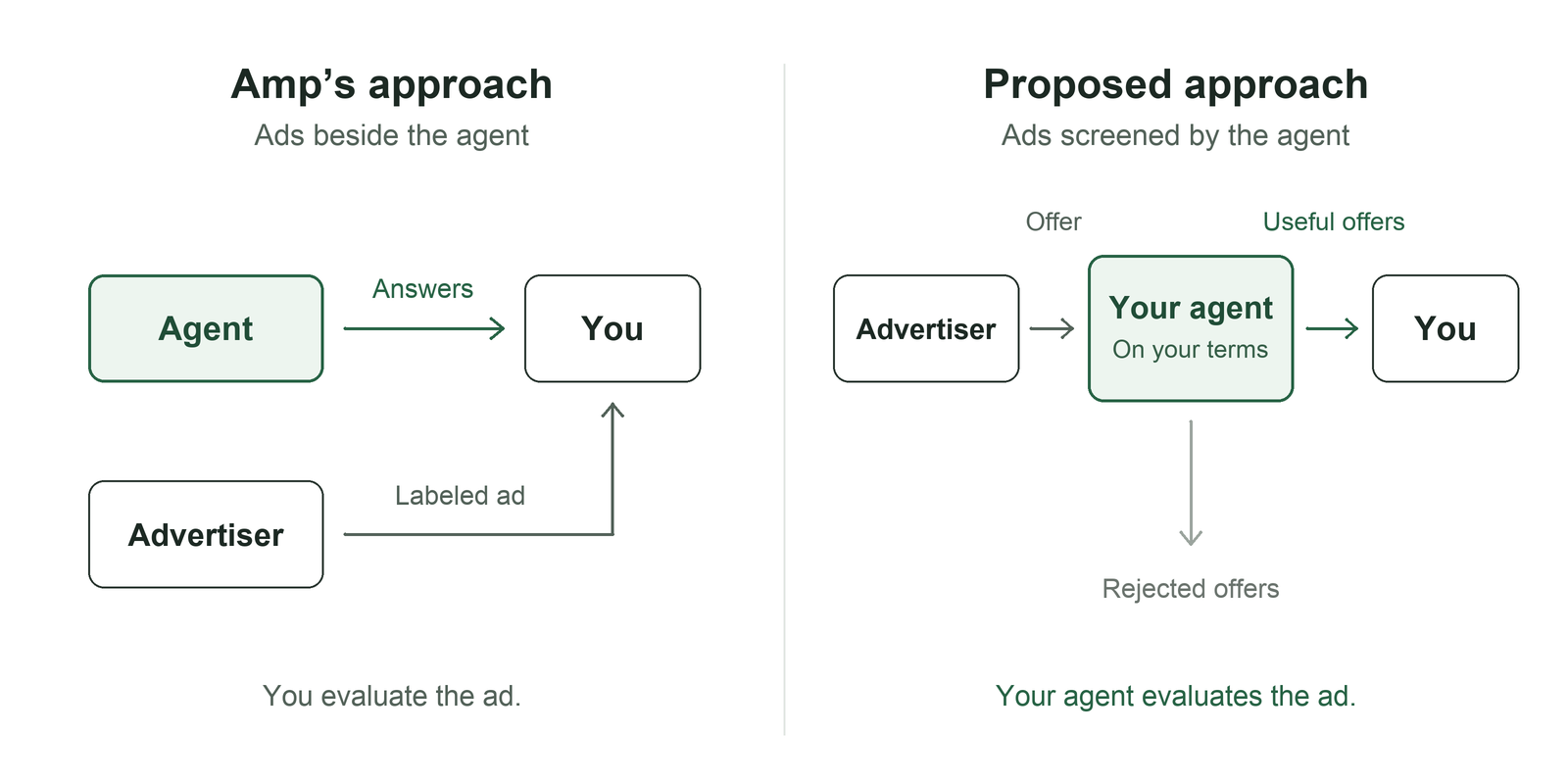
In this world, suppose I need authentication, my agent could compare a sponsored provider with competing services, open-source options, and whatever my project already uses. It could check pricing, how much work is needed for integration, and figure out whether switching creates more problems than it solves. I could even give it permission to run the actual product in a sandbox before suggesting adoption.
This kind of dynamic introduces a new proof-of-use ad SKU. An advertiser gets a chance to prove usefulness. Ads that simply depend on a distracted human never reach me, and ads that pass a live trial with my agent do. This creates a potential win-win scenario. As a user, I get recommendations tested against my own project. As an advertiser, you get a buyer who needs what you sell and has already vetted that it works for them.
I suspect this sort of dynamic will take off first for utility products with clear evals like devtools or infra. In these categories the eval can be honest because it's measurable, and if a product fails the eval it loses access to my attention, no matter what the advertiser pays. This may be the only kind of ad that survives in a sacred place where trust matters above all else.